



Trump has threatened a “tremendous tax” on American companies building AI data centres outside the US, citing competition with China.
India's nearly $160 billion data centre investment pipeline could face uncertainty if US technology companies reconsider overseas projects.
Google, Amazon and Microsoft are expanding their AI and cloud infrastructure in India as the country seeks to become a global data centre hub.
US President Donald Trump has threatened to impose a “tremendous tax” on American companies that build artificial intelligence (AI) data centres outside the country, arguing that keeping the infrastructure within the US is necessary to compete with China. The proposed move could affect countries such as India, which are attracting billions of dollars in investments from American technology companies seeking to expand their cloud computing and AI infrastructure.
Trump made the announcement at a White House news conference on November 20, shortly after returning from Asia. “We're not going to allow companies to build data centres in other countries. If they do that, they can. But we're going to put a tremendous tax on them,” he said. He argued that overseas construction could allow China to gain an advantage in the AI race.
India is seeking to become a global hub for AI and cloud infrastructure, attracting investments from major American technology companies. Trump's threat raises questions about whether these companies could reconsider planned projects if overseas construction attracts additional taxes.


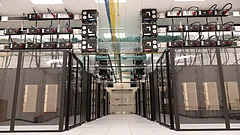

Why Does Trump Want US Data Centres To Stay At Home?
Data centres house servers, storage systems and networking equipment that process and store digital information. They provide the computing capacity required for AI models, cloud services and other online applications.
As demand for AI increases, technology companies are investing heavily in large-scale data centres. However, AI is not their only purpose. Cloud computing remains a major use of these facilities, which also support digital payments, online services and enterprise data storage.
Trump has framed the proposal as part of the US competition with China. Washington is also concerned that Chinese companies can access advanced American AI chips by renting computing capacity at data centres in countries permitted to import them, bypassing restrictions on direct chip sales to China. At the November 20 news conference, he said, “We're not allowing data centres to go into other countries, because China will take all of them.” He also referred to a proposed data centre in Finland, indicating that his remarks were directed at overseas construction more broadly.
Trump's push for domestic construction comes amid growing opposition to data centres over electricity consumption, utility bills and pressure on local water supplies.
According to the Associated Press (AP), about three-quarters of US voters in the 2026 midterm elections opposed the construction of a new data centre in their communities.
A separate survey by the Associated Press-NORC Center for Public Affairs Research and the Energy Policy Institute at the University of Chicago found that around six in 10 Americans supported limiting the number of new facilities. A September 2026 Pew Research Center survey also found that 54 per cent of Americans viewed data centres as mostly bad for the environment, while half said they were mostly bad for household energy costs.
Trump has nevertheless urged communities to negotiate financial benefits from technology companies seeking approval for new projects. “Make the deal,” he said. “They have plenty of money. Take it.”
Why Do US Technology Companies Build Data Centres Abroad?
Companies build data centres abroad to serve customers closer to where they are based, reduce delays in digital services and meet local regulatory requirements.
Reuters reported that data centre developers often establish facilities near their users to reduce latency, or the time taken for data to travel between systems. This is particularly important for services that require rapid responses, including digital payments and other time-sensitive applications.
Data localisation laws also require companies in some countries to store or process certain categories of information locally, making overseas infrastructure necessary.
A US tax on overseas construction could therefore affect more than companies looking to expand their physical presence abroad. It could influence how American technology firms organise their international cloud networks and deliver services to customers in different markets.
However, Trump has not clarified whether the tax would apply only to companies constructing facilities, those owning them or businesses using leased data centre capacity.
Why Is India At Risk?
India has become an important destination for data centre investments, supported by its expanding digital economy, growing demand for cloud services and government incentives.
The Ministry of Electronics and Information Technology says India's installed data centre capacity rose from 375 MW in 2020 to 1.57 GW in August 2026 and could reach nearly 8 GW by 2030.
A September 2026 PIB backgrounder put investments underway in India's data centre sector at nearly $70 billion, with another $90 billion in announced projects.
American technology companies are among those expanding their presence. Google has announced a $15 billion investment over five years, from 2026 to 2030, for an AI hub in Visakhapatnam, Andhra Pradesh. The project includes gigawatt-scale data centre operations, energy infrastructure and an expanded fibre-optic network. Microsoft now operates four cloud regions in India, while Amazon plans to invest more than $21 billion in AI and cloud infrastructure in the country between 2026 and 2030.
India has also introduced tax incentives to attract foreign cloud service providers. Under the Union Budget 2026-27, eligible foreign companies can receive a tax holiday until 2047 for providing global cloud services using specified data centres in India. To qualify, the foreign company must be notified by the government and procure services from a data centre set up under an approved scheme, notified by the Ministry of Electronics and Information Technology (MeitY), and owned and operated by an Indian company. Services to Indian customers must be routed through an Indian reseller. The Budget also provides a 15 per cent safe harbour margin on cost for data centre services supplied by related entities.
The incentive could make India more attractive to foreign cloud providers, but it would not automatically offset any additional US tax liability.
Could India Lose Out If Trump Implements The Proposal?
If the US imposes heavy taxes on companies building data centres overseas, American technology firms could delay projects or redirect investments to the US, affecting India's plans to expand its AI and cloud infrastructure.
India has not been specifically named by Trump, who cited Finland as one example of overseas construction. The proposal remains vague: no tax rate, legal framework or enforcement mechanism has been announced. Trump also said he had not discussed it with his officials before making the announcement, AP reported.
For now, the threat does not mean existing investments will be withdrawn. But if the US moves ahead with the proposal, planned projects by American technology companies in India could face delays or reconsideration.







