Protests and demonstrations are a part of democratic processes. But just as lawyers distinguish the consequences of a wrong decision within jurisdiction from those of a wrong decision beyond jurisdiction, public protests, too, can be within the four corners of the rule of law or in response to the absence of the rule of law. The current protests for accountability of the CEC appear to be precariously poised on the dividing line.
As an officer of the Court, when I hear distinguished colleagues express a complete lack of confidence and faith in the Supreme Court, despite having reasons to be deeply disappointed, I worry about the impact that will have on ordinary citizens.
Similarly, when I see colleagues at the Bar being physically dragged and inelegantly carried by their limbs, I am forced to ask myself in shock if the Rubicon has been crossed irretrievably. Are we well beyond dissent and disagreement and in the landscape of revolution? Be that as it may, the Court’s emphasis on Article 19 freedoms is a timely reiteration of liberty.
One might add that what was on display by the police during the protests was more like prevention rather than cautious facilitation. The police have a duty to ensure security but are equally obliged to facilitate the exercise of rights by citizens.


The Right To Protest And The Role Of Lawyers
Although various groups of lawyers are out on the streets, the Supreme Court heard some counsel at a special sitting on Sunday, 11 October 2026. Although it was to hear a contempt petition, the Court issued directions granting relief in terms of removing unnecessary commuting restrictions and underscoring the right to protest, subject to reasonable restrictions. It is salutary that the Court observed that lawyers have a right to participate in protests.
However, a clear difference of opinion emerged amongst the assembled lawyers when one lawyer speaking on behalf of the government side declared that lawyers should speak in court, not in the streets. There was a spontaneous reaction from the younger members of the Bar. Be that as it may, lawyers are citizens as well, though specially equipped and placed in society.
Whilst enforcement agencies should always show a degree of deference and respect for their role as upholders of the law, they, in turn, need to remain conscious that it is their bounden duty to preserve the dignity of the very courts that give them their status and standing.
A breakdown of mutual trust and respect between lawyers and the enforcement agencies would be a grievous loss to our civil society. Advocates of dialogue argue that this path should not be abandoned. But then there is a contrary view, perhaps not to be dismissed out of hand, that, in the name of protecting the authority and dignity of constitutional office, we do not end up permitting the very institutions to undermine their integrity.
The choice is a difficult one and involves one’s conscience. We need to go back to Gandhiji’s lessons on satyagraha. Our fight is for more than just integrity in the application of electoral [law]; it is for honest adherence to constitutional morality.

A People’s Movement And The Question Of Accountability
The missive by the leaders of the INDIA group to the CJI was responded to by the Chief Justice with reasons for not being able to meet the leaders in person. But the desire for an early hearing of the entire ECI matter was clearly accepted in terms of the filing of a petition.
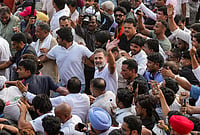
Admittedly, the support that poured out on the streets of central Delhi, backing the filing of the petition, was historic and may be said to be the battle half won in terms of perception. Legally, the petition is on firm ground in any case. It is clear now that this is a genuine people’s movement and not merely a political strategy.
The amplification of the conundrum of conscientious objection and rejection in the matter of governance is not far to seek. We have an example in the Arab Spring and, nearer home, in the political upheavals in Sri Lanka, Bangladesh and Nepal.
These movements for fundamental change were very costly for the countries concerned but reached resolution within unity within a short period, unlike the preceding civil wars that extracted a protracted price and divided society.
India’s own moment of challenge and change is, for the present, about rules being followed rather than a rejection of rules, and the reaffirmation of fundamental beliefs rather than an overhaul of its structures.

The Cockroach Janata Party And The Political Opposition
The special feature about the present agitation is the emergence of the Cockroach Janata Party. Its impact on public discourse cannot be denied, but it is still early to assess its ability to sustain a multidimensional movement challenging the system rather than an episodic series of challenges to passing events.
Without meaning to undermine its effort and achievement, the constructive role of the political Opposition, led by the Congress party under the stewardship of Rahul Gandhi, must not be lost sight of. Parliamentary Opposition in our system provides the alternative to the establishment, for now and the future: the former as a commentary on the present and the latter as a promise for the future.
Often, protracted agitations themselves lead to alternative manifestos emerging. Strategically, it is important to keep the focus on the glaring failures of the incumbent government and not be distracted by the debate over what would replace all that. In due course, understandably, elections are held on a manifesto of change, sometimes general and at others more specific.

Constitutional Morality And The Supreme Court’s Role
To return to the role of lawyers and courts, it seems too late in the day to take shelter in the doctrine of political questions. Inevitably, political questions arrive on the Court’s docket and are required to be adjudicated. The Court is fortified in its dealings by the concept of constitutional morality.
This has served the Court admirably in deeply contested questions of law, including the Electoral Bonds, reservations and Article 370 cases. But when public opinion becomes deeply divided and knocks on the door of the Supreme Court, the question is whether constitutional morality can hold its ground against the deep divide in public opinion.
There are two major strands of thinking and social ideologies that confront each other in contemporary India. One believes in plurality, inclusiveness and unity in diversity, whilst the other adheres to uniformity. In politics, they both have support, but which one complies with the constitutional arrangement is impliedly, and sometimes even explicitly, contested.
Popular narratives might speak of judges having different inclinations, but how these guide their decisions is a moot question. Fortunately, there is widespread agreement on ideas like liberty, equality and fraternity, even if there may be variations in applying them to specific instances. The months ahead will not just test what the streets decide but also what the highest court of the land decides.
The overlap between the Court of Justice and the court of the people might become critical to confining the political contest to reaffirming the rule of law. The days ahead will focus attention on the Court being persuaded to become proactive, despite the Chief Justice having advised potential litigants to keep politics away from the precincts of the courts.
(Views are personal)